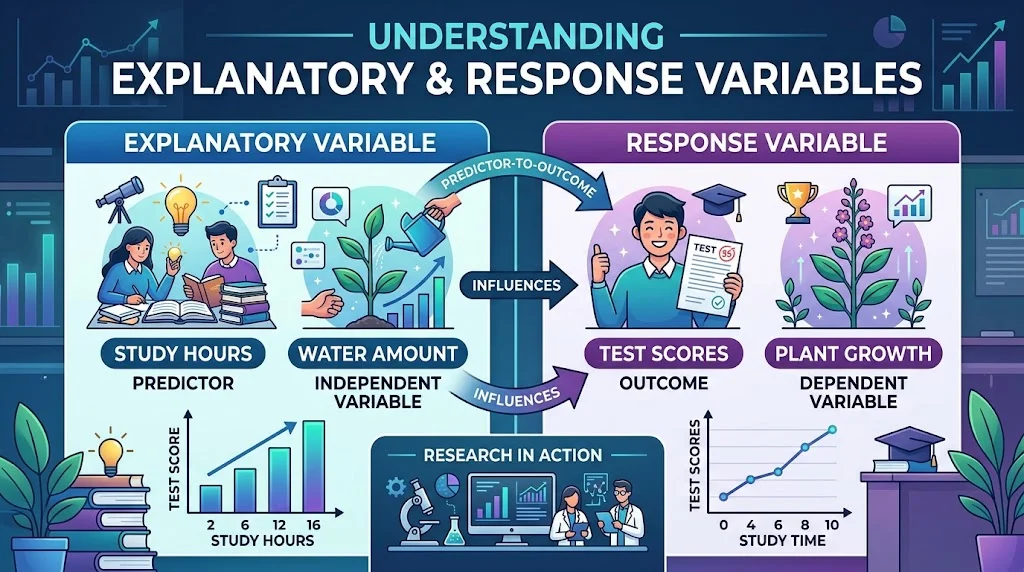
Explanatory variable vs response variable becomes much easier when you remember the simple rule: the explanatory variable helps explain or predict a change, while the response variable is what gets measured. Think cause or predictor → measured outcome.
Top alternatives: predictor vs outcome, independent vs dependent variable, input vs output variable, cause vs effect variable, explanatory vs measured variable
When statistics starts throwing around terms like explanatory variable and response variable, it can feel like your textbook suddenly switched languages. The good news? The idea is much simpler than the terminology makes it sound.
You are working on homework, studying for an exam, analyzing survey data, or trying to explain a graph to a friend, knowing the difference matters. The explanatory variable vs response variable distinction tells you which variable is being used to explain or predict and which variable is being measured as the result.
Think of it as the statistical version of “what might influence something?” versus “what happened?” Once that connection clicks, scatterplots, experiments, research questions, and data tables become much easier to understand. No statistical wizard hat required.
1. Simple Explanatory Variable Responses
- The predictor explains the outcome
Use this when introducing the basic relationship between variables.
Meaning: The explanatory variable helps account for changes in another variable. - The response variable gets measured
Use this when identifying the outcome in a study.
Meaning: The response variable represents the result researchers observe. - Explanatory means predicting change
Use this when remembering what the explanatory variable does.
Meaning: It is commonly used to explain or predict variation. - Response means measured result
Use this for a quick definition during studying.
Meaning: The response variable is the outcome being observed. - Predictor first, outcome second
Use this as an easy memory trick.
Meaning: The explanatory variable generally comes before the measured response conceptually. - X usually explains Y
Use this shorthand when reading statistical notation.
Meaning: X often represents the explanatory variable and Y the response. - Y responds to X
Use this when connecting variables conceptually.
Meaning: The response variable is examined in relation to the explanatory variable. - Input helps explain output
Use this analogy for beginners.
Meaning: The explanatory variable resembles an input while the response resembles an output. - Cause-like predictor, measured outcome
Use this when simplifying the distinction.
Meaning: One variable provides explanatory information while the other provides the measured result. - Explain first, measure second
Use this as a quick study reminder.
Meaning: The predictor provides explanation while the response provides the observed measurement. - Variable roles depend context
Use this when avoiding rigid assumptions.
Meaning: A variable’s role depends on the research question. - Question determines each role
Use this before labeling variables.
Meaning: The study’s question determines which variable explains and which responds.
2. Funny Explanatory Variable Responses
- X makes the data talk
Use this playful phrase during casual studying.
Meaning: The explanatory variable helps reveal patterns in the data. - Y is the main character
Use this when remembering the measured outcome.
Meaning: The response variable is the result receiving attention. - X asks, Y answers
Use this as a memorable classroom shortcut.
Meaning: The explanatory variable raises the explanatory question while the response reflects results. - Data drama starts with X
Use this when making statistics feel less intimidating.
Meaning: X represents the predictor involved in the relationship. - Y catches the consequences
Use this playful explanation for beginners.
Meaning: The response variable reflects observed changes associated with the predictor. - X brings the plot twist
Use this for a memorable study note.
Meaning: Changes in X can help explain patterns in Y. - Y gets measured, obviously
Use this when reviewing basic definitions.
Meaning: The response variable is the quantity researchers actually observe. - X predicts, Y reacts
Use this short mnemonic in study sessions.
Meaning: X is explanatory while Y is the response. - Statistics loves simple labels
Use this when terminology feels overwhelming.
Meaning: Clear labels make variable relationships easier to understand. - X enters, Y responds
Use this as a quick memory phrase.
Meaning: The explanatory variable is linked to the observed response. - Think predictor, then outcome
Use this before answering a variable question.
Meaning: This sequence helps identify the two roles. - No statistical drama required
Use this to keep studying light.
Meaning: The distinction becomes straightforward once the roles are understood.
3. Friendly Explanatory Variable Responses
- Start by finding the predictor
Use this when helping someone identify X.
Meaning: First determine which variable is being used for explanation. - Then locate the measured result
Use this after identifying the predictor.
Meaning: The measured result is usually the response variable. - Ask what changes what
Use this simple question during homework.
Meaning: It helps uncover the relationship being studied. - Find what researchers measure
Use this when identifying the response variable.
Meaning: The measured outcome is generally the response. - Look for the research question
Use this when labels seem confusing.
Meaning: The question often reveals each variable’s intended role. - Think predictor and outcome
Use this as an easy mental shortcut.
Meaning: The predictor corresponds to explanatory information and outcome to response. - Read the sentence carefully
Use this before labeling variables.
Meaning: Wording often reveals which variable explains and which responds. - Check what gets predicted
Use this when working with regression questions.
Meaning: The predicted quantity is typically the response variable. - Check what does predicting
Use this while reviewing relationships.
Meaning: The predictor is generally the explanatory variable. - Keep the roles separate
Use this when two variables seem interchangeable.
Meaning: Their statistical roles should be identified from context. - Context beats memorization here
Use this during exam preparation.
Meaning: Understanding the question is more useful than memorizing labels. - Simple questions reveal roles
Use this for quick revision.
Meaning: Asking what explains and what responds clarifies the relationship.
4. Professional Explanatory Variable Responses
- Identify the explanatory variable first
Use this in formal statistical analysis.
Meaning: The explanatory variable serves as the predictor or explanatory factor. - Determine the response measurement
Use this when reviewing research data.
Meaning: The response variable represents the measured outcome. - Define roles before analysis
Use this when preparing a statistical model.
Meaning: Clear variable roles support accurate interpretation. - Consider the research objective
Use this when variables appear ambiguous.
Meaning: The study objective determines how variables are classified. - Examine the proposed relationship
Use this during data interpretation.
Meaning: The relationship helps establish explanatory and response roles. - Identify the predicted quantity
Use this in regression contexts.
Meaning: The predicted quantity is generally the response variable. - Identify the predictor variable
Use this when reading statistical models.
Meaning: The predictor typically serves as the explanatory variable. - Separate predictors from outcomes
Use this when organizing research variables.
Meaning: Predictors and measured outcomes have different analytical roles. - Interpret variables within context
Use this in research reports.
Meaning: Variable classification depends on the study’s purpose. - Avoid assuming causation automatically
Use this when interpreting observational studies.
Meaning: An explanatory relationship does not automatically prove causation. - Use labels consistently throughout
Use this when writing statistical explanations.
Meaning: Consistent terminology prevents confusion during analysis. - Connect variables to research questions
Use this when explaining methodology.
Meaning: Research questions provide context for assigning variable roles.
5. Clever Explanatory Variable Responses
- Ask who explains whom
Use this as a clever memory trick.
Meaning: The explaining variable is explanatory while the other is responsive. - Find the prediction target
Use this when solving regression questions.
Meaning: The prediction target is usually the response variable. - Find the prediction source
Use this when identifying X.
Meaning: The prediction source is usually the explanatory variable. - X explains, Y records
Use this as a compact revision note.
Meaning: X provides explanatory information while Y records the outcome. - Predictor versus target, simple
Use this when distinguishing statistical roles.
Meaning: The predictor is explanatory and the target is responsive. - Follow the research question
Use this when labels feel uncertain.
Meaning: The research question establishes the intended variable relationship. - Look beyond the variable names
Use this when names seem misleading.
Meaning: Context matters more than labels such as X or Y. - Outcome reveals the response
Use this while studying experiments.
Meaning: The observed outcome identifies the response variable. - Prediction reveals the explanation
Use this when reading models.
Meaning: The variable used for prediction is generally explanatory. - Roles matter more than symbols
Use this when X and Y switch positions.
Meaning: Symbols are conventions, not permanent definitions. - Question first, labels second
Use this before answering exam questions.
Meaning: Understand the research question before assigning variable roles. - Context unlocks the answer
Use this when stuck between two variables.
Meaning: Context determines which variable explains and which responds.
6. Educational Explanatory Variable Responses
- Explanatory variables predict responses
Use this in classroom notes.
Meaning: Explanatory variables are used to understand or predict response variation. - Response variables measure outcomes
Use this when defining the dependent concept.
Meaning: Response variables capture the observed result. - Variables have different statistical roles
Use this when introducing the topic.
Meaning: The same variable can play different roles in different studies. - Research questions establish those roles
Use this during lessons.
Meaning: The question determines what is explanatory and responsive. - Regression often uses both
Use this when connecting concepts to models.
Meaning: Regression commonly predicts a response using explanatory variables. - Scatterplots display both variables
Use this while studying graphs.
Meaning: Scatterplots can visualize relationships between explanatory and response variables. - Correlation describes their association
Use this when reviewing paired data.
Meaning: Correlation summarizes the direction and strength of association. - Causation requires stronger evidence
Use this when studying experiments.
Meaning: Association alone does not establish a causal relationship. - Experimental design clarifies roles
Use this when reviewing controlled studies.
Meaning: Experiments can clearly define explanatory factors and measured responses. - Observational studies need context
Use this when interpreting real-world data.
Meaning: Observational relationships should not automatically be treated as causal. - Variables connect through questions
Use this for revision notes.
Meaning: The research question creates the framework for interpreting variables. - Definitions make graphs easier
Use this before studying scatterplots.
Meaning: Understanding roles makes graphical interpretation more intuitive.
7. Comparison-Focused Responses
- Explanatory predicts, response measures
Use this as the quickest comparison.
Meaning: One variable predicts while the other records the outcome. - Explanatory is predictor, response outcome
Use this for side-by-side revision.
Meaning: The predictor is explanatory and the outcome is responsive. - X explains, Y responds
Use this for simple examples.
Meaning: X commonly represents explanation and Y commonly represents response. - Input differs from measured output
Use this when explaining variable roles.
Meaning: The explanatory variable resembles an input while response represents output. - Predictor differs from target
Use this in regression examples.
Meaning: The predictor helps estimate the target response. - Question determines the difference
Use this when variables seem interchangeable.
Meaning: Their roles depend on the research question. - Both variables can be numerical
Use this when studying quantitative examples.
Meaning: Variable type does not alone determine its role. - Both can appear on graphs
Use this when reviewing scatterplots.
Meaning: Graphs can display both explanatory and response variables together. - Roles are not permanent
Use this for advanced understanding.
Meaning: A variable can change roles across different research questions. - Labels depend upon context
Use this when reviewing examples.
Meaning: Context determines the appropriate classification. - Prediction direction matters here
Use this when reading regression problems.
Meaning: The direction of prediction helps identify variable roles. - Measure the outcome carefully
Use this during study design.
Meaning: Accurate response measurement is essential for meaningful analysis.
8. Example-Based Explanatory Variable Responses
- Study hours explain test scores
Use this when studying education examples.
Meaning: Study hours can be explanatory while scores become the response. - Temperature explains ice cream sales
Use this in a business example.
Meaning: Temperature may predict changes in sales. - Exercise explains heart rate
Use this for a simple science example.
Meaning: Exercise level can serve as the explanatory variable. - Advertising explains product sales
Use this for marketing examples.
Meaning: Advertising exposure may help predict sales outcomes. - Rainfall explains crop yield
Use this in environmental studies.
Meaning: Rainfall can help explain variation in crop production. - Age explains reaction time
Use this in psychology examples.
Meaning: Age may be used to predict differences in reaction time. - Price explains demand levels
Use this in economics examples.
Meaning: Price can be examined as a predictor of demand. - Sleep explains concentration scores
Use this in health research examples.
Meaning: Sleep duration can help predict concentration measurements. - Practice explains performance scores
Use this for sports research examples.
Meaning: Practice time may explain differences in performance. - Distance explains travel time
Use this in transportation examples.
Meaning: Distance can help predict how long travel takes. - Fertilizer explains plant growth
Use this in biology examples.
Meaning: Fertilizer amount may help explain growth differences. - Screen time explains sleep duration
Use this in lifestyle research examples.
Meaning: Screen time can be studied as a predictor of sleep duration.
9. Exam-Friendly Explanatory Variable Responses
- Find what predicts first
Use this when answering multiple-choice questions.
Meaning: The predictor is generally the explanatory variable. - Find what gets measured
Use this when identifying the response.
Meaning: The measured outcome is usually the response variable. - Circle the outcome variable
Use this during quick exam preparation.
Meaning: Marking the outcome helps identify the response variable. - Underline the predictor variable
Use this while analyzing a question.
Meaning: The predictor generally identifies the explanatory variable. - Read the question twice
Use this when wording feels tricky.
Meaning: Careful reading can reveal each variable’s role. - Ignore confusing variable names
Use this when X and Y seem misleading.
Meaning: Symbols do not determine statistical roles by themselves. - Focus on prediction direction
Use this during regression questions.
Meaning: Prediction direction often reveals explanatory and response roles. - Check what researchers want explained
Use this for word problems.
Meaning: The quantity being explained is generally the response. - Check what explains variation
Use this when identifying the predictor.
Meaning: The explanatory variable helps account for variation. - Think predictor versus outcome
Use this as an exam shortcut.
Meaning: This contrast quickly separates the two roles. - Use context, not guesswork
Use this when questions contain unfamiliar examples.
Meaning: Context determines the correct classification. - Keep the definition simple
Use this before submitting an answer.
Meaning: Simple definitions often prevent unnecessary confusion.
10. Statistical Explanatory Variable Responses
- Explanatory variables support prediction
Use this in statistics coursework.
Meaning: They provide information used to predict response values. - Response variables represent outcomes
Use this in statistical reports.
Meaning: They capture the measured results of interest. - Regression models connect both
Use this when studying regression.
Meaning: Regression commonly models responses using explanatory variables. - Scatterplots reveal relationships visually
Use this when reviewing data displays.
Meaning: Scatterplots show patterns between paired variables. - Correlation measures association strength
Use this during statistics revision.
Meaning: Correlation summarizes the strength and direction of association. - Residuals evaluate model errors
Use this when studying regression diagnostics.
Meaning: Residuals represent differences between observed and predicted responses. - Prediction does not prove causation
Use this when interpreting observational data.
Meaning: A predictive relationship does not automatically establish cause and effect. - Context guides statistical interpretation
Use this in research analysis.
Meaning: Statistical results must be understood within their study context. - Variable roles guide modeling
Use this before building a model.
Meaning: Identifying roles helps determine how variables enter an analysis. - Response selection shapes conclusions
Use this when designing research.
Meaning: Choosing the response determines what outcome the analysis focuses on. - Predictors can include multiple variables
Use this when studying multiple regression.
Meaning: Several explanatory variables can jointly predict one response. - One response can have predictors
Use this when learning regression structure.
Meaning: A response variable may be explained using one or more predictors.
11. Social-Media-Friendly Explanatory Variable Responses
- X explains the data tea
Use this as a playful study caption.
Meaning: The explanatory variable helps reveal what may influence the outcome. - Y is where results land
Use this for a quick educational post.
Meaning: The response variable represents the observed result. - Predictor energy meets outcome energy
Use this for a fun statistics graphic.
Meaning: The two variables play different but connected roles. - Statistics, but make it simple
Use this for beginner-friendly content.
Meaning: The distinction can be understood without complicated language. - X predicts, Y reports back
Use this as a social caption.
Meaning: X predicts while Y provides the measured response. - Your data has two roles
Use this for an educational carousel.
Meaning: Variables can serve explanatory or response roles. - Plot twist: context matters
Use this when teaching variable classification.
Meaning: Context determines which variable takes each role. - Think predictor, not alphabet
Use this when explaining X and Y.
Meaning: Variable symbols do not define their statistical roles. - The graph has a storyline
Use this for visual learning content.
Meaning: One variable helps explain patterns in another. - Data gets easier here
Use this for beginner study content.
Meaning: Recognizing roles makes statistical problems easier. - No math panic needed
Use this for a friendly study post.
Meaning: The concept is primarily about understanding variable roles. - Save this stats shortcut
Use this for educational social content.
Meaning: The predictor-versus-outcome rule is useful for quick revision.
12. Beginner-Friendly Explanatory Variable Responses
- Ask what you want explained
Use this as the first beginner step.
Meaning: The desired explanation helps identify the response variable. - Find what might explain it
Use this after identifying the outcome.
Meaning: The possible explanation becomes the explanatory variable. - Response means observed outcome
Use this for first-time learners.
Meaning: The response is what gets measured. - Explanatory means useful predictor
Use this when learning terminology.
Meaning: The explanatory variable helps predict or explain variation. - Start with the research question
Use this before labeling variables.
Meaning: The question establishes the relationship being examined. - Then identify both variables
Use this after reading the question.
Meaning: Once the context is clear, assign each statistical role. - Look for measured results
Use this to find the response.
Meaning: Measured results generally represent the response variable. - Look for predicting factors
Use this to find the explanatory variable.
Meaning: Predicting factors generally serve as explanatory variables. - Do not overthink X and Y
Use this when symbols cause confusion.
Meaning: Symbols are simply notation and do not determine roles. - Use real-world cause language carefully
Use this when explaining observational studies.
Meaning: Explanatory does not automatically mean proven cause. - Practice with simple examples
Use this during early study sessions.
Meaning: Familiar examples make variable roles easier to recognize. - Keep predictor and outcome separate
Use this as the final beginner rule.
Meaning: Separating these roles prevents common classification mistakes.
13. Research-Focused Explanatory Variable Responses
- Research questions establish variable roles
Use this during study design.
Meaning: The research objective determines which variable explains and which responds. - Outcomes become response variables
Use this when designing a study.
Meaning: The primary measured result usually serves as the response. - Predictors become explanatory variables
Use this when listing study factors.
Meaning: Variables used to explain variation are explanatory. - Study design affects interpretation
Use this when discussing research methods.
Meaning: Design influences what conclusions can reasonably be drawn. - Experiments strengthen causal interpretation
Use this when discussing controlled studies.
Meaning: Experimental control can provide stronger evidence about causal effects. - Observational data shows associations
Use this when reviewing nonexperimental research.
Meaning: Observational studies can reveal relationships without proving causation. - Variables need clear definitions
Use this when preparing research plans.
Meaning: Clear operational definitions improve consistency and interpretation. - Measurements should match objectives
Use this during study planning.
Meaning: The response should reflect the research question accurately. - Predictors should be theoretically relevant
Use this in research discussions.
Meaning: Explanatory variables should have a meaningful connection to the research question. - Context remains essential throughout
Use this in data interpretation.
Meaning: Statistical roles and findings require contextual understanding. - Interpret relationships with caution
Use this after analyzing results.
Meaning: Associations should not automatically be described as causal. - Clear roles improve reporting
Use this when writing research findings.
Meaning: Consistent variable roles make conclusions easier to understand.
14. Quick Memory Responses
- Predictor equals explanatory
Use this as a two-second memory trick.
Meaning: The predictor is generally the explanatory variable. - Outcome equals response
Use this during exam revision.
Meaning: The measured outcome is generally the response variable. - X explains, Y responds
Use this as your main shortcut.
Meaning: X commonly represents the explanatory variable and Y the response. - Predict first, measure afterward
Use this when remembering the sequence.
Meaning: Prediction is associated with explanatory variables and measurement with responses. - What changes is explanatory
Use this only when context supports that interpretation.
Meaning: A changing predictor can help explain changes in the response. - What changes back is response
Use this as a simple conceptual reminder.
Meaning: The response reflects variation associated with the explanatory variable. - Find the target outcome
Use this when reading a statistical problem.
Meaning: The target outcome is generally the response. - Find the prediction source
Use this when identifying the explanatory variable.
Meaning: The prediction source is generally explanatory. - Question before labels
Use this when the roles seem unclear.
Meaning: Always understand the research question before labeling variables. - Context before conclusions
Use this when interpreting relationships.
Meaning: Statistical relationships require appropriate contextual interpretation. - Symbols are not definitions
Use this when X and Y seem confusing.
Meaning: Variable roles depend on context rather than notation. - Keep this shortcut handy
Use this before a statistics test.
Meaning: Predictor versus outcome is a useful starting point.
15. Confident Explanatory Variable Responses
- I know the predictor
Use this when confidently identifying the explanatory variable.
Meaning: The predictor is the variable used for explanation. - I found the outcome
Use this when confidently identifying the response.
Meaning: The outcome is the measured response variable. - The roles are clear now
Use this after analyzing the question.
Meaning: The explanatory and response roles have been correctly separated. - Context makes this obvious
Use this when variable labels initially seem confusing.
Meaning: The research context reveals the intended roles. - Predictor versus outcome, easy
Use this as a confident revision note.
Meaning: The distinction becomes simple when viewed as predictor versus outcome. - X explains the variation
Use this when identifying explanatory information.
Meaning: X is being treated as the explanatory variable. - Y records the result
Use this when identifying the response.
Meaning: Y represents the measured response. - The question gives clues
Use this during difficult word problems.
Meaning: Research wording often reveals variable roles. - The outcome tells everything
Use this as a quick reminder.
Meaning: Identifying the measured outcome often reveals the response variable. - The predictor starts the story
Use this as a memorable phrase.
Meaning: The explanatory variable provides information used to explain the outcome. - Statistics suddenly makes sense
Use this after understanding the distinction.
Meaning: Clear variable roles make many statistical problems easier. - Predict, measure, understand
Use this as a final study mantra.
Meaning: Identify the predictor, measure the response, then interpret the relationship.
FAQs
1. What is an explanatory variable?
An explanatory variable is used to explain or predict changes in another variable. It is often called a predictor.
2. What is a response variable?
A response variable is the measured outcome in a study. It is often called the outcome or dependent variable.
3. Are explanatory and response variables always X and Y?
Not necessarily. X and Y are common conventions, but the research context determines each variable’s role.
4. Is an explanatory variable always the cause?
No. Calling something explanatory does not automatically prove causation, especially in observational studies.
5. Can both variables be numerical?
Yes. Both explanatory and response variables can be numerical, categorical, or represented in different data formats.
6. How can I remember the difference?
Think predictor versus outcome. The explanatory variable predicts or explains, while the response variable is measured.
7. What is the easiest example?
If study hours are used to predict test scores, study hours are explanatory and test scores are the response.
Conclusion
Understanding explanatory variable vs response variable does not have to feel like decoding a statistics textbook at midnight. The easiest approach is to ask two questions: What variable helps explain or predict? and What variable is being measured? The first is generally the explanatory variable, while the second is the response variable.
Remember that context matters, and explanatory does not automatically mean causal. Once you practice with everyday examples like study time and test scores, temperature and sales, or distance and travel time, the difference becomes much easier to spot.
Try different examples, save this guide for revision, and share it with anyone currently battling statistics homework. You have got this.
Discover More Related Articles:
- 180+ American Eagle Sydney Sweeney Response | Ideas for Every Mood & Situation In 2026
- 200+ Security Orchestration Automation & Response | Phrases for Faster Cybersecurity Conversations In 2026
- 180+ American Medical Response |Phrases, Replies & Helpful Ways to Respond In 2026











3 thoughts on “350+ Explanatory Variable vs Response Variable In 2026”