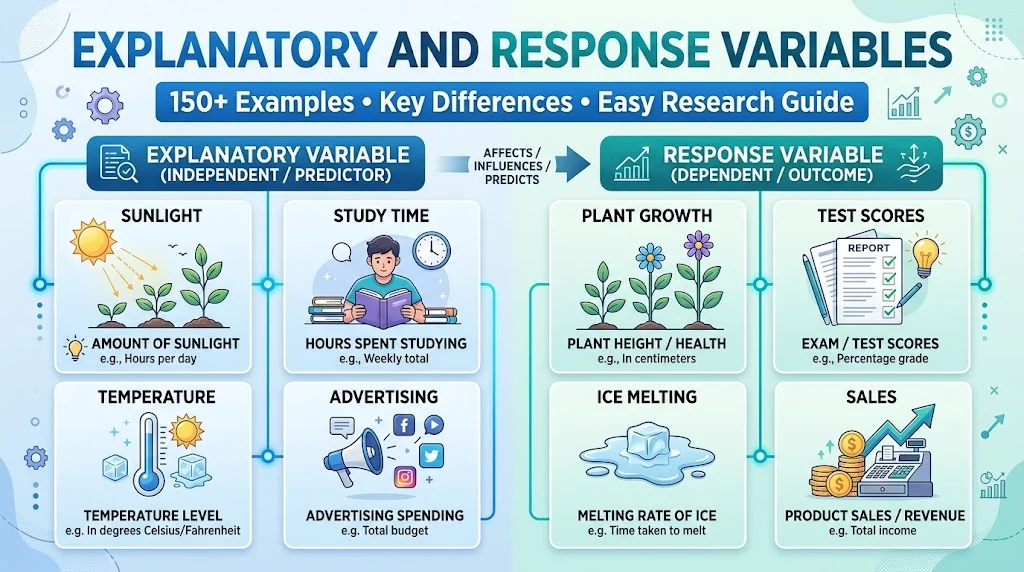
Explanatory and response variables are two essential concepts in research, science, statistics, and experiments. An explanatory variable is the factor that may influence or explain a change, while a response variable is the outcome being measured. Understanding their differences makes experiments, data analysis, and everyday research much easier.
Top alternatives: Independent and dependent variables, predictor and outcome variables, cause and effect variables, input and output variables, experimental and measured variables.
Ever wondered why some experiments produce surprising results while others seem surprisingly easy to understand? The secret often lies in identifying explanatory and response variables correctly. You’re working on a science project, studying statistics, preparing a research paper, or answering homework questions, these two variables play an important role in understanding relationships between different factors.
Explanatory and response variables help researchers organize information, explore patterns, and understand how one factor might relate to another. From examining how study time relates to test scores to exploring how sunlight affects plant growth, these variables appear in countless real-life situations. However, mixing them up can make even a simple experiment confusing. Knowing how to identify them can make your research clearer and your conclusions more meaningful. Let’s explore practical examples, different explanations, and easy ways to recognize these variables without turning statistics into a headache.
1. Simple Explanatory and Response Variables Examples
• Study Time and Test Scores Example: A student investigates additional study time is associated with higher test scores. Meaning: Study time is the explanatory variable, while test scores are the response variable.
• Sunlight and Plant Growth Example: A gardening experiment examines how different amounts of sunlight relate to plant growth. Meaning: Sunlight is the explanatory variable, and plant growth is the response variable.
• Exercise and Heart Rate Example: A researcher records heart rates after different levels of physical activity. Meaning: Exercise intensity is the explanatory variable, while heart rate is the response variable.
• Water and Plant Height Example: A science project compares plant heights when plants receive different amounts of water. Meaning: Water quantity is the explanatory variable, and plant height is the response variable.
• Sleep and Concentration Example: A study explores the relationship between nightly sleep duration and concentration scores. Meaning: Sleep duration is the explanatory variable, while concentration is the response variable.
• Temperature and Ice Melting Example: An experiment measures how quickly ice melts at different temperatures. Meaning: Temperature is the explanatory variable, and melting time is the response variable.
• Reading Time and Vocabulary Example: A teacher examines students who read longer tend to know more vocabulary words. Meaning: Reading time is the explanatory variable, while vocabulary scores are the response variable.
• Fertilizer and Plant Growth Example: A gardener compares plant growth using different fertilizer amounts. Meaning: Fertilizer quantity is the explanatory variable, and plant growth is the response variable.
• Screen Time and Sleep Duration Example: A researcher investigates the relationship between daily screen time and sleep duration. Meaning: Screen time is the explanatory variable, while sleep duration is the response variable.
• Practice and Sports Performance Example: A coach studies practice hours are related to athletic performance. Meaning: Practice hours are the explanatory variable, and performance is the response variable.
• Rainfall and Crop Yield Example: A farmer examines how seasonal rainfall relates to crop production. Meaning: Rainfall is the explanatory variable, and crop yield is the response variable.
• Advertising and Sales Example: A business examines advertising expenditure is associated with monthly sales. Meaning: Advertising expenditure is the explanatory variable, while sales are the response variable.
2. Funny Explanatory and Response Variables Examples
• Coffee and Morning Productivity Example: An office worker tracks coffee consumption and completed tasks during the morning. Meaning: Coffee consumption is the explanatory variable, while completed tasks are the response variable.
• Pizza and Happiness Example: A student explores the number of pizza slices eaten is associated with reported happiness. Meaning: Pizza consumption is the explanatory variable, and reported happiness is the response variable.
• Alarm Snoozes and Arrival Time Example: Someone records how many times they snooze their alarm and when they arrive at school. Meaning: Alarm snoozes are the explanatory variable, while arrival time is the response variable.
• Memes and Laughter Example: A class measures how many funny memes participants view and how often they laugh. Meaning: The number of memes is the explanatory variable, and laughter frequency is the response variable.
• Video Games and Reaction Time Example: A researcher explores gaming hours are associated with reaction-time scores. Meaning: Gaming hours are the explanatory variable, while reaction time is the response variable.
• Snacks and Homework Completion Example: A student records snack breaks and homework completion times. Meaning: Snack breaks are the explanatory variable, while homework completion time is the response variable.
• Music and Dancing Example: An experiment examines different music tempos relate to the number of dance movements performed. Meaning: Music tempo is the explanatory variable, and movement count is the response variable.
• Rainy Days and Movie Watching Example: A researcher compares rainy-day frequency with the number of movies watched each month. Meaning: Rainy-day frequency is the explanatory variable, while movie count is the response variable.
• Cat Videos and Smiles Example: A student measures how many cat videos people watch and how frequently they smile. Meaning: Video count is the explanatory variable, while smiling frequency is the response variable.
• Bedtime and Morning Mood Example: A survey explores bedtime is associated with self-reported morning mood. Meaning: Bedtime is the explanatory variable, and morning mood is the response variable.
• Chocolate and Study Breaks Example: A researcher records chocolate consumption and the number of study breaks taken. Meaning: Chocolate consumption is the explanatory variable, while break frequency is the response variable.
• Weekend Plans and Excitement Example: A survey examines the number of planned weekend activities relates to reported excitement. Meaning: Planned activities are the explanatory variable, and excitement is the response variable.
3. Academic Explanatory and Response Variables Examples
• Teaching Methods and Academic Achievement Example: A researcher compares different teaching methods with students’ examination results. Meaning: Teaching method is the explanatory variable, while examination results are the response variable.
• Class Attendance and Grades Example: An education study examines the relationship between attendance rates and final grades. Meaning: Attendance rate is the explanatory variable, and final grades are the response variable.
• Revision Frequency and Exam Scores Example: A researcher investigates revision frequency is associated with examination performance. Meaning: Revision frequency is the explanatory variable, while exam scores are the response variable.
• Class Size and Learning Outcomes Example: A school compares class sizes with students’ learning assessment results. Meaning: Class size is the explanatory variable, and learning outcomes are the response variable.
• Homework Time and Mathematics Scores Example: An education project measures homework time and mathematics assessment scores. Meaning: Homework time is the explanatory variable, while mathematics scores are the response variable.
• Library Visits and Reading Achievement Example: A researcher studies library visit frequency relates to reading assessment scores. Meaning: Library visits are the explanatory variable, and reading scores are the response variable.
• Online Learning and Course Completion Example: A study examines how online learning participation relates to course completion rates. Meaning: Online participation is the explanatory variable, while completion rate is the response variable.
• Feedback Frequency and Writing Quality Example: A teacher investigates feedback frequency is associated with writing assessment results. Meaning: Feedback frequency is the explanatory variable, and writing quality is the response variable.
• Tutoring Sessions and Test Performance Example: A researcher compares tutoring attendance with students’ test results. Meaning: Tutoring attendance is the explanatory variable, while test performance is the response variable.
• Note-Taking Methods and Recall Example: A classroom experiment compares different note-taking methods with memory test scores. Meaning: Note-taking method is the explanatory variable, and recall score is the response variable.
• Classroom Lighting and Reading Speed Example: A study examines reading speed under different classroom lighting conditions. Meaning: Lighting condition is the explanatory variable, while reading speed is the response variable.
• Group Discussions and Participation Example: A teacher studies discussion formats are associated with student participation rates. Meaning: Discussion format is the explanatory variable, and participation rate is the response variable.
4. Scientific Explanatory and Response Variables Examples
• Water Temperature and Dissolving Time Example: A laboratory experiment measures how long sugar takes to dissolve at different water temperatures. Meaning: Water temperature is the explanatory variable, while dissolving time is the response variable.
• Light Intensity and Photosynthesis Example: A biology experiment examines how different light intensities relate to photosynthesis rates. Meaning: Light intensity is the explanatory variable, and photosynthesis rate is the response variable.
• Salt Concentration and Freezing Point Example: A chemistry experiment measures freezing points at different salt concentrations. Meaning: Salt concentration is the explanatory variable, while freezing point is the response variable.
• Pressure and Gas Volume Example: A physics experiment records gas volume under different pressure conditions while controlling temperature. Meaning: Pressure is the explanatory variable, and gas volume is the response variable.
• Acidity and Enzyme Activity Example: A laboratory study measures enzyme activity at different pH levels. Meaning: pH level is the explanatory variable, while enzyme activity is the response variable.
• Wind Speed and Turbine Output Example: An engineering experiment measures electricity production at different wind speeds. Meaning: Wind speed is the explanatory variable, and electricity output is the response variable.
• Surface Type and Friction Example: A physics project compares friction measurements across different surfaces. Meaning: Surface type is the explanatory variable, while friction is the response variable.
• Temperature and Chemical Reaction Rate Example: A chemistry experiment measures reaction rates at different temperatures. Meaning: Temperature is the explanatory variable, while reaction rate is the response variable.
• Water Salinity and Seed Germination Example: A biology experiment compares seed germination rates in water with different salt concentrations. Meaning: Salinity is the explanatory variable, and germination rate is the response variable.
• Magnetic Strength and Object Movement Example: A physics investigation measures the movement of objects exposed to different magnetic field strengths. Meaning: Magnetic field strength is the explanatory variable, while object movement is the response variable.
• Air Resistance and Falling Speed Example: A physics experiment examines how parachute surface area relates to falling speed. Meaning: Parachute surface area is the explanatory variable, while falling speed is the response variable.
• Nutrient Concentration and Algae Growth Example: A biology study investigates how nutrient concentrations relate to algae growth. Meaning: Nutrient concentration is the explanatory variable, and algae growth is the response variable.
5. Everyday Life Explanatory and Response Variables Examples
• Commute Distance and Travel Time Example: A commuter records different journey distances and the time needed to complete them. Meaning: Distance is the explanatory variable, while travel time is the response variable.
• Shopping Time and Spending Example: A shopper tracks time spent in stores and the amount spent during each visit. Meaning: Shopping time is the explanatory variable, while spending is the response variable.
• Daily Steps and Walking Time Example: A person compares daily step counts with total walking time. Meaning: Step count is the explanatory variable, and walking time is the response variable.
• Cooking Temperature and Baking Time Example: A cooking experiment compares oven temperatures with the time required to bake similar recipes. Meaning: Oven temperature is the explanatory variable, while baking time is the response variable.
• Water Consumption and Plant Condition Example: A gardener records watering amounts and plant condition over several weeks. Meaning: Water quantity is the explanatory variable, and plant condition is the response variable.
• Traffic Density and Journey Duration Example: A commuter examines the relationship between traffic density and journey duration. Meaning: Traffic density is the explanatory variable, while journey duration is the response variable.
• Household Electricity Use and Monthly Bills Example: A household compares monthly electricity consumption with electricity bills. Meaning: Electricity consumption is the explanatory variable, and bill amount is the response variable.
• Laundry Load and Washing Time Example: A household experiment examines how laundry load size relates to washing time. Meaning: Load size is the explanatory variable, while washing time is the response variable.
• Daily Temperature and Ice Cream Sales Example: A shop owner compares daily temperatures with ice cream sales. Meaning: Daily temperature is the explanatory variable, and ice cream sales are the response variable.
• Walking Speed and Arrival Time Example: A student records walking speed and the time taken to reach school. Meaning: Walking speed is the explanatory variable, while arrival time is the response variable.
• Room Temperature and Fan Usage Example: A household records indoor temperature and daily fan usage. Meaning: Room temperature is the explanatory variable, and fan usage is the response variable.
• Meal Preparation Time and Recipe Complexity Example: A cook examines recipe complexity relates to meal preparation time. Meaning: Recipe complexity is the explanatory variable, while preparation time is the response variable.
6. Business Explanatory and Response Variables Examples
• Marketing Budget and Revenue Example: A company studies the relationship between monthly marketing expenditure and revenue. Meaning: Marketing expenditure is the explanatory variable, while revenue is the response variable.
• Product Price and Sales Volume Example: A retailer compares different product prices with the number of units sold. Meaning: Product price is the explanatory variable, and sales volume is the response variable.
• Customer Service and Satisfaction Example: A business surveys customers about service quality and their satisfaction ratings. Meaning: Service quality is the explanatory variable, while satisfaction ratings are the response variable.
• Store Location and Foot Traffic Example: A retailer compares store locations with daily visitor counts. Meaning: Store location is the explanatory variable, and visitor count is the response variable.
• Delivery Time and Customer Ratings Example: A delivery company investigates delivery times are associated with customer ratings. Meaning: Delivery time is the explanatory variable, while customer ratings are the response variable.
• Employee Training and Productivity Example: A business examines training hours are associated with employee productivity. Meaning: Training hours are the explanatory variable, while productivity is the response variable.
• Website Design and Conversion Rate Example: An online store compares different website layouts with conversion rates. Meaning: Website design is the explanatory variable, and conversion rate is the response variable.
• Discount Rate and Purchase Volume Example: A retailer examines how different discount rates relate to purchase volume. Meaning: Discount rate is the explanatory variable, while purchase volume is the response variable.
• Inventory Level and Stockouts Example: A business investigates the relationship between inventory levels and stockout frequency. Meaning: Inventory level is the explanatory variable, and stockout frequency is the response variable.
• Email Frequency and Engagement Example: A marketing team compares email frequency with customer engagement rates. Meaning: Email frequency is the explanatory variable, while engagement rate is the response variable.
• Opening Hours and Customer Visits Example: A store evaluates different opening hours relate to daily customer visits. Meaning: Opening hours are the explanatory variable, while customer visits are the response variable.
• Packaging Design and Purchase Intent Example: A company surveys customers about different packaging designs and their purchase intentions. Meaning: Packaging design is the explanatory variable, while purchase intention is the response variable.
7. Environmental Explanatory and Response Variables Examples
• Rainfall and River Levels Example: An environmental researcher studies the relationship between rainfall and river water levels. Meaning: Rainfall is the explanatory variable, while river level is the response variable.
• Air Pollution and Visibility Example: A researcher measures visibility under different air pollution conditions. Meaning: Pollution concentration is the explanatory variable, while visibility is the response variable.
• Temperature and Snowfall Example: A meteorologist examines how temperature relates to snowfall amounts. Meaning: Temperature is the explanatory variable, and snowfall is the response variable.
• Deforestation and Soil Erosion Example: An environmental study compares forest-cover levels with soil erosion measurements. Meaning: Forest cover is the explanatory variable, while soil erosion is the response variable.
• Water Pollution and Fish Population Example: A researcher investigates how water pollution levels relate to fish population estimates. Meaning: Pollution level is the explanatory variable, and fish population is the response variable.
• Urbanization and Green Space Example: A city planner examines the relationship between urbanization and available green space. Meaning: Urbanization level is the explanatory variable, while green-space availability is the response variable.
• Wind Speed and Soil Loss Example: An environmental experiment measures soil loss under different wind speeds. Meaning: Wind speed is the explanatory variable, and soil loss is the response variable.
• Rainfall and Plant Diversity Example: A field study examines how rainfall patterns relate to plant diversity. Meaning: Rainfall is the explanatory variable, while plant diversity is the response variable.
• Noise Levels and Bird Activity Example: A researcher records bird activity in locations with different noise levels. Meaning: Noise level is the explanatory variable, while bird activity is the response variable.
• Water Depth and Aquatic Vegetation Example: An ecological study compares water depths with aquatic vegetation coverage. Meaning: Water depth is the explanatory variable, and vegetation coverage is the response variable.
• Temperature and Electricity Demand Example: An energy researcher investigates how outdoor temperatures relate to electricity demand. Meaning: Temperature is the explanatory variable, while electricity demand is the response variable.
• Tree Cover and Local Temperature Example: A city study examines tree coverage is associated with neighborhood temperatures. Meaning: Tree coverage is the explanatory variable, while local temperature is the response variable.
8. Health and Lifestyle Explanatory and Response Variables Examples
• Physical Activity and Endurance Example: A study examines the relationship between physical activity levels and endurance test results. Meaning: Physical activity is the explanatory variable, while endurance is the response variable.
• Sleep Duration and Alertness Example: A researcher compares sleep duration with daytime alertness scores. Meaning: Sleep duration is the explanatory variable, while alertness is the response variable.
• Hydration and Exercise Performance Example: A study investigates how hydration levels relate to exercise performance. Meaning: Hydration level is the explanatory variable, while performance is the response variable.
• Walking Frequency and Stamina Example: A researcher records walking frequency and measures stamina during a fitness assessment. Meaning: Walking frequency is the explanatory variable, while stamina is the response variable.
• Screen Time and Eye Strain Example: A survey examines daily screen time is associated with reported eye strain. Meaning: Screen time is the explanatory variable, while reported eye strain is the response variable.
• Breakfast Habits and Concentration Example: A school study investigates breakfast habits are related to concentration scores. Meaning: Breakfast habits are the explanatory variable, while concentration is the response variable.
• Exercise Duration and Recovery Time Example: A fitness study records exercise duration and recovery time after activity. Meaning: Exercise duration is the explanatory variable, while recovery time is the response variable.
• Daily Routine and Stress Ratings Example: A survey examines different daily routines are associated with reported stress ratings. Meaning: Daily routine is the explanatory variable, and stress rating is the response variable.
• Outdoor Activity and Mood Example: A study explores the relationship between outdoor activity time and self-reported mood. Meaning: Outdoor activity time is the explanatory variable, while mood is the response variable.
• Caffeine Consumption and Sleep Quality Example: A researcher investigates caffeine consumption is associated with sleep quality ratings. Meaning: Caffeine consumption is the explanatory variable, while sleep quality is the response variable.
• Stretching and Flexibility Example: A fitness experiment compares stretching routines with flexibility assessment results. Meaning: Stretching routine is the explanatory variable, and flexibility is the response variable.
• Meal Timing and Energy Levels Example: A survey explores how meal timing relates to self-reported energy levels. Meaning: Meal timing is the explanatory variable, while energy level is the response variable.
9. Funny and Creative Research Examples
• Pet Ownership and Happiness Example: A student explores pet ownership is associated with reported happiness. Meaning: Pet ownership is the explanatory variable, while happiness is the response variable.
• Favorite Music and Cleaning Speed Example: A researcher compares music genres with the time people take to clean a room. Meaning: Music genre is the explanatory variable, while cleaning time is the response variable.
• Emoji Use and Message Responses Example: A social media study examines emoji frequency relates to message response rates. Meaning: Emoji frequency is the explanatory variable, while response rate is the response variable.
• Plant Names and Gardening Interest Example: A survey explores plant naming habits are associated with gardening interest. Meaning: Plant naming is the explanatory variable, while gardening interest is the response variable.
• Funny Socks and Compliments Example: A student investigates different sock designs relate to the number of compliments received. Meaning: Sock design is the explanatory variable, while compliment count is the response variable.
• Board Games and Social Interaction Example: A researcher compares different board games with observed social interaction frequency. Meaning: Board game type is the explanatory variable, while interaction frequency is the response variable.
• Colorful Notebooks and Note-Taking Example: A classroom survey examines notebook design relates to note-taking frequency. Meaning: Notebook design is the explanatory variable, while note-taking frequency is the response variable.
• Movie Genre and Audience Ratings Example: A film study compares movie genres with audience rating averages. Meaning: Movie genre is the explanatory variable, while audience rating is the response variable.
• Phone Wallpapers and Personalization Example: A survey explores wallpaper choices relate to reported phone personalization habits. Meaning: Wallpaper type is the explanatory variable, while personalization habits are the response variable.
• Game Difficulty and Completion Time Example: A gaming study measures completion times at different difficulty levels. Meaning: Game difficulty is the explanatory variable, while completion time is the response variable.
• Party Themes and Guest Participation Example: An event planner examines party themes relate to guest participation rates. Meaning: Party theme is the explanatory variable, while participation rate is the response variable.
• Cartoon Characters and Product Preferences Example: A survey investigates cartoon character designs relate to children’s product preferences. Meaning: Character design is the explanatory variable, while product preference is the response variable.
10. Statistical Explanatory and Response Variables Examples
• Age and Reaction Time Example: A statistical study examines the relationship between age and reaction-time measurements. Meaning: Age is the explanatory variable, while reaction time is the response variable.
• Income and Household Spending Example: An economist investigates the relationship between household income and monthly spending. Meaning: Income is the explanatory variable, while household spending is the response variable.
• Advertising and Website Visits Example: A data analyst compares advertising expenditure with website traffic. Meaning: Advertising expenditure is the explanatory variable, while website visits are the response variable.
• Distance and Fuel Consumption Example: A transportation study examines how journey distance relates to fuel consumption. Meaning: Journey distance is the explanatory variable, while fuel consumption is the response variable.
• Temperature and Energy Usage Example: An analyst examines how outdoor temperature relates to household energy consumption. Meaning: Temperature is the explanatory variable, while energy consumption is the response variable.
• Experience and Task Completion Example: A workplace study compares employee experience with task completion times. Meaning: Experience is the explanatory variable, while task completion time is the response variable.
• Product Price and Customer Demand Example: An economist investigates how product prices relate to customer demand. Meaning: Product price is the explanatory variable, while demand is the response variable.
• Population Density and Traffic Congestion Example: A city researcher studies the association between population density and traffic congestion. Meaning: Population density is the explanatory variable, while congestion is the response variable.
• Advertising Exposure and Brand Recognition Example: A marketing analyst examines how advertising exposure relates to brand recognition scores. Meaning: Advertising exposure is the explanatory variable, while brand recognition is the response variable.
• Distance to School and Attendance Example: A researcher investigates students’ travel distances are associated with attendance rates. Meaning: Travel distance is the explanatory variable, while attendance rate is the response variable.
• Product Ratings and Purchase Intent Example: A data analyst explores product ratings are associated with purchase intentions. Meaning: Product ratings are the explanatory variable, while purchase intention is the response variable.
• Temperature and Daily Water Use Example: A statistical study compares daily temperatures with household water consumption. Meaning: Temperature is the explanatory variable, while water consumption is the response variable.
11. Professional Explanatory and Response Variables Examples
• Employee Experience and Job Performance Example: A human resources analyst studies the association between work experience and performance ratings. Meaning: Work experience is the explanatory variable, while performance rating is the response variable.
• Training Hours and Error Rates Example: A company evaluates employee training hours relate to workplace error rates. Meaning: Training hours are the explanatory variable, while error rates are the response variable.
• Customer Wait Time and Satisfaction Example: A service manager examines how customer wait times relate to satisfaction scores. Meaning: Wait time is the explanatory variable, while satisfaction score is the response variable.
• Meeting Frequency and Project Progress Example: A project manager studies meeting frequency is associated with project milestones completed. Meaning: Meeting frequency is the explanatory variable, while milestone completion is the response variable.
• Remote Work Frequency and Productivity Example: A workplace survey examines the relationship between remote work frequency and productivity ratings. Meaning: Remote work frequency is the explanatory variable, while productivity rating is the response variable.
• Communication Methods and Response Time Example: A business compares communication methods with average response times. Meaning: Communication method is the explanatory variable, while response time is the response variable.
• Workload and Project Completion Example: A manager examines workload levels are associated with project completion times. Meaning: Workload is the explanatory variable, while completion time is the response variable.
• Customer Feedback and Service Improvements Example: A company investigates feedback volume is associated with the number of service improvements. Meaning: Feedback volume is the explanatory variable, while improvement count is the response variable.
• Office Temperature and Employee Comfort Example: A workplace survey explores how office temperature relates to comfort ratings. Meaning: Office temperature is the explanatory variable, while comfort rating is the response variable.
• Software Training and Task Accuracy Example: An organization compares software training formats with employee task accuracy. Meaning: Training format is the explanatory variable, while task accuracy is the response variable.
• Response Time and Customer Retention Example: A company examines the relationship between customer support response time and retention rates. Meaning: Response time is the explanatory variable, while retention rate is the response variable.
• Work Schedule and Attendance Example: An organization studies different work schedules relate to attendance rates. Meaning: Work schedule is the explanatory variable, while attendance rate is the response variable.
12. Creative Explanatory and Response Variables Examples for Students
• Notebook Color and Organization Example: A student investigates notebook colors are associated with organization ratings. Meaning: Notebook color is the explanatory variable, while organization rating is the response variable.
• Study Location and Concentration Example: A student compares concentration scores across different study locations. Meaning: Study location is the explanatory variable, while concentration score is the response variable.
• Flashcards and Vocabulary Recall Example: A classroom experiment examines how different flashcard methods relate to vocabulary recall. Meaning: Flashcard method is the explanatory variable, while vocabulary recall is the response variable.
• Revision Schedule and Quiz Results Example: A student compares different revision schedules with quiz scores. Meaning: Revision schedule is the explanatory variable, while quiz score is the response variable.
• Study Music and Reading Speed Example: A project measures reading speed while students study with different types of background music. Meaning: Music type is the explanatory variable, while reading speed is the response variable.
• Desk Arrangement and Group Participation Example: A teacher investigates desk arrangements relate to group participation. Meaning: Desk arrangement is the explanatory variable, while group participation is the response variable.
• Question Difficulty and Completion Time Example: A student examines how question difficulty relates to answer completion time. Meaning: Question difficulty is the explanatory variable, while completion time is the response variable.
• Practice Tests and Confidence Ratings Example: A survey explores the number of practice tests completed relates to confidence ratings. Meaning: Practice test count is the explanatory variable, while confidence rating is the response variable.
• Reading Format and Comprehension Example: A researcher compares printed and digital reading formats with comprehension scores. Meaning: Reading format is the explanatory variable, while comprehension score is the response variable.
• Group Size and Discussion Time Example: A student measures discussion time in groups of different sizes. Meaning: Group size is the explanatory variable, while discussion time is the response variable.
• Study Breaks and Task Accuracy Example: A classroom project examines different study-break schedules relate to task accuracy. Meaning: Break schedule is the explanatory variable, while task accuracy is the response variable.
• Presentation Style and Audience Attention Example: A student compares presentation styles with audience attention ratings. Meaning: Presentation style is the explanatory variable, while attention rating is the response variable.
13. Tricky Explanatory and Response Variables Examples
• Ice Cream Sales and Temperature Example: A researcher investigates daily temperatures are associated with ice cream sales. Meaning: Temperature is the explanatory variable, while sales are the response variable, although other factors may also influence sales.
• Exercise and Fitness Scores Example: A researcher studies the association between weekly exercise frequency and fitness assessment scores. Meaning: Exercise frequency is the explanatory variable, while fitness scores are the response variable, but other lifestyle factors may matter.
• Education and Income Example: An economist examines the relationship between educational attainment and income. Meaning: Education is the explanatory variable, while income is the response variable, although the association does not establish causation.
• Rainfall and Plant Growth Example: A botanist compares rainfall measurements with plant growth in different locations. Meaning: Rainfall is the explanatory variable, while plant growth is the response variable, with soil conditions potentially affecting both.
• Age and Technology Use Example: A survey explores the relationship between age and daily technology use. Meaning: Age is the explanatory variable, while technology use is the response variable.
• Price and Product Demand Example: An analyst studies how product prices relate to demand while considering seasonal trends. Meaning: Price is the explanatory variable, while demand is the response variable, although seasonality may influence the relationship.
• Sleep and Academic Performance Example: A researcher examines sleep duration is associated with examination scores. Meaning: Sleep duration is the explanatory variable, while examination scores are the response variable, but study habits may also contribute.
• Traffic and Delivery Delays Example: A logistics company investigates traffic density is associated with delivery delays. Meaning: Traffic density is the explanatory variable, while delivery delays are the response variable.
• Advertising and Customer Growth Example: A business examines advertising spending is associated with customer growth. Meaning: Advertising spending is the explanatory variable, while customer growth is the response variable, although market conditions can influence both.
• Water Quality and Fish Health Example: An ecologist examines how water quality measurements relate to fish health indicators. Meaning: Water quality is the explanatory variable, while fish health is the response variable.
• Class Size and Test Results Example: An education researcher investigates class size is associated with standardized test results. Meaning: Class size is the explanatory variable, while test results are the response variable, although student backgrounds may also matter.
• Social Media Use and Attention Example: A researcher explores the association between social media use and attention scores. Meaning: Social media use is the explanatory variable, while attention score is the response variable, but the relationship alone cannot establish which factor influences the other.
14. Advanced Explanatory and Response Variables Examples
• Multiple Study Factors and Academic Performance Example: A researcher analyzes study hours, attendance, and sleep duration in relation to examination results. Meaning: Study hours, attendance, and sleep duration are explanatory variables, while examination results are the response variable.
• Advertising Channels and Sales Revenue Example: A marketing analyst compares spending on social media, television, and email advertising with sales revenue. Meaning: Advertising channels and their spending levels are explanatory variables, while sales revenue is the response variable.
• Climate Factors and Crop Production Example: An agricultural study examines temperature, rainfall, and soil moisture in relation to crop yield. Meaning: Temperature, rainfall, and soil moisture are explanatory variables, while crop yield is the response variable.
• Multiple Training Methods and Productivity Example: A workplace study examines training duration, training format, and experience in relation to productivity. Meaning: Training duration, format, and experience are explanatory variables, while productivity is the response variable.
• Housing Features and Property Prices Example: A property researcher investigates how location, floor area, and property age relate to sale prices. Meaning: Location, floor area, and property age are explanatory variables, while sale price is the response variable.
• Dietary Patterns and Energy Levels Example: A survey investigates how meal timing, breakfast frequency, and food variety relate to reported energy levels. Meaning: Meal timing, breakfast frequency, and food variety are explanatory variables, while energy level is the response variable.
• Traffic Conditions and Fuel Consumption Example: A transportation researcher examines speed, traffic density, and journey distance in relation to fuel consumption. Meaning: Speed, traffic density, and journey distance are explanatory variables, while fuel consumption is the response variable.
• Website Features and Conversion Rates Example: A business evaluates page layout, loading time, and navigation design in relation to conversion rates. Meaning: Layout, loading time, and navigation design are explanatory variables, while conversion rate is the response variable.
• Environmental Conditions and Biodiversity Example: An ecologist studies temperature, rainfall, and habitat size in relation to species diversity. Meaning: Temperature, rainfall, and habitat size are explanatory variables, while species diversity is the response variable.
• Customer Characteristics and Purchase Behavior Example: A retailer analyzes customer age groups, browsing frequency, and product ratings in relation to purchasing behavior. Meaning: Age group, browsing frequency, and product ratings are explanatory variables, while purchasing behavior is the response variable.
• Learning Conditions and Memory Scores Example: A researcher investigates study duration, background noise, and lighting in relation to memory scores. Meaning: Study duration, background noise, and lighting are explanatory variables, while memory score is the response variable.
• Transportation Options and Commuting Time Example: A city planner compares transportation mode, route distance, and traffic conditions with commuting time. Meaning: Transportation mode, distance, and traffic conditions are explanatory variables, while commuting time is the response variable.
15. Practical Explanatory and Response Variables Examples for Research
• Social Media Posts and Engagement Example: A researcher examines posting frequency is associated with social media engagement. Meaning: Posting frequency is the explanatory variable, while engagement is the response variable.
• Advertising Format and Click-Through Rate Example: A marketing experiment compares different advertisement formats with click-through rates. Meaning: Advertisement format is the explanatory variable, while click-through rate is the response variable.
• Teaching Resources and Student Progress Example: An education researcher examines how different teaching resources relate to student progress. Meaning: Teaching resources are the explanatory variable, while student progress is the response variable.
• Packaging Materials and Product Durability Example: A laboratory experiment compares packaging materials with product damage measurements. Meaning: Packaging material is the explanatory variable, while product damage is the response variable.
• Watering Frequency and Flowering Example: A gardening experiment examines how watering frequency relates to flowering. Meaning: Watering frequency is the explanatory variable, while flowering is the response variable.
• Website Loading Time and User Engagement Example: A web analyst studies the relationship between page loading time and user engagement. Meaning: Loading time is the explanatory variable, while user engagement is the response variable.
• Customer Discounts and Repeat Purchases Example: A retailer investigates discount availability is associated with repeat purchases. Meaning: Discount availability is the explanatory variable, while repeat purchases are the response variable.
• Road Conditions and Accident Frequency Example: A transportation study examines how road conditions relate to recorded accident frequency. Meaning: Road conditions are the explanatory variable, while accident frequency is the response variable.
• Study Environment and Productivity Example: A student research project compares study environments with completed assignments. Meaning: Study environment is the explanatory variable, while completed assignments are the response variable.
• Temperature and Battery Performance Example: An engineering experiment measures battery performance under different temperatures. Meaning: Temperature is the explanatory variable, while battery performance is the response variable.
• Public Transport Frequency and Passenger Numbers Example: A transportation researcher investigates how service frequency relates to passenger numbers. Meaning: Service frequency is the explanatory variable, while passenger numbers are the response variable.
• Customer Reviews and Product Ratings Example: A researcher explores the number of customer reviews is associated with average product ratings. Meaning: Review count is the explanatory variable, while average product rating is the response variable.
FAQs
What are explanatory and response variables?
An explanatory variable is used to explain or predict changes in another variable. A response variable is the outcome being measured or predicted.
What is the difference between explanatory and response variables?
The explanatory variable is the potential predictor, while the response variable is the measured outcome. Their roles depend on the research question.
Are explanatory and independent variables the same?
They are closely related, but not always identical. Explanatory variables can be observed rather than experimentally controlled.
Are response and dependent variables the same?
They are often used interchangeably in introductory statistics. Both commonly refer to the outcome being studied.
Can explanatory variables be categorical?
Yes. Variables such as teaching method, product type, and transportation mode can all be explanatory variables.
Can response variables be numerical?
Yes. Test scores, temperature, sales, and reaction time are common numerical response variables.
Can a study have multiple explanatory variables?
Yes. Researchers frequently examine several explanatory variables to understand how they relate to one response variable.
Can a study have multiple response variables?
Yes. A research project can measure several outcomes, such as plant height and leaf count.
How do I identify an explanatory variable?
Look for the factor used to explain, predict, or investigate changes in another variable.
How do I identify a response variable?
Look for the outcome that the researcher measures, records, or tries to predict.
Conclusion
Understanding explanatory and response variables can make statistics, science projects, and research questions much easier to handle. Once you recognize which variable explains a possible relationship and which one represents the measured outcome, identifying them becomes a straightforward task.
From classroom experiments to business research and everyday observations, these concepts help organize information and reveal meaningful patterns. Remember that an association between variables does not automatically prove cause and effect, so always consider other possible influences.
Use these examples as a reference whenever you need to identify variables or prepare a research project. Save this guide, share it with classmates, and revisit it whenever statistics starts feeling complicated.
Discover More Related Articles:
- 450+ Emergency Response System | Messages & Essential Communication Tips In 2026
- 350+ Explanatory Variable vs Response Variable In 2026
- 450+ Cyber Security Incident Response In 2026










